Two points can be distinct as elements of a set and yet represent the same object once a specified class of transformations is declared irrelevant. This elementary observation appears throughout geometry, but it also suggests a useful order in which to construct invariant comparisons: first determine what counts as the same object, then ask how to distinguish the resulting equivalence classes.
The categorical language of group actions makes this order precise. The orbit-space construction is universal among invariant maps, and its adjunction with the trivial-action functor explains why an invariant representation necessarily factors through a quotient. A distance on the original space may then yield a distance between orbits, provided the action and metric satisfy suitable hypotheses.
The purpose of this note is to organize invariant comparisons around the universal property of an orbit quotient, separating categorical statements from the additional metric assumptions they require.
1. Actions, equivariance, and invariance
Let \(G\) be a group acting on a set \(X\) on the left. Thus there is a map
\[ a:G\times X\longrightarrow X,\qquad (g,x)\longmapsto g\cdot x, \]
such that \(e\cdot x=x\) and \(g\cdot(h\cdot x)=(gh)\cdot x\). We call \(X\), together with this action, a \(G\)-set.
If \(X\) and \(Z\) are \(G\)-sets, a map \(u:X\to Z\) is equivariant when
\[ u(g\cdot x)=g\cdot u(x) \qquad(g\in G,\ x\in X). \]
The \(G\)-sets and equivariant maps form a category, denoted \(G\text{-}\mathbf{Set}\). Equivariance is a property of a map between two spaces with actions. Invariance is the special case in which the target carries the trivial action:
\[ f(g\cdot x)=f(x). \]
Equivariance therefore retains the information about how an object transforms, while invariance forgets differences within each orbit.
The orbit of \(x\in X\) is \(Gx=\{g\cdot x:g\in G\}\). The set of orbits is written \(X/G\), and the canonical projection is
\[ \pi_X:X\longrightarrow X/G,\qquad x\longmapsto[x]. \]
Because \(\pi_X(g\cdot x)=\pi_X(x)\), the projection is invariant.
2. The quotient as a universal invariant
The key assertion is more informative than the fact that \(\pi_X\) is invariant.
Proposition (universal property of orbits). Let \(Y\) be a set and let \(f:X\to Y\) be invariant under \(G\). There exists a unique map \(\bar f:X/G\to Y\) such that
\[ f=\bar f\circ\pi_X. \]
In other words, the following triangle commutes:
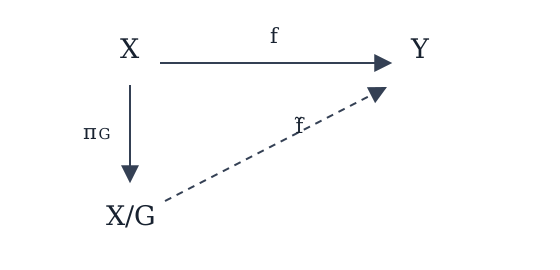
Proof. Define \(\bar f([x])=f(x)\). If \([x]=[x']\), then \(x'=g\cdot x\) for some \(g\in G\), hence \(f(x')=f(x)\); thus \(\bar f\) is well-defined. It gives the required factorization. Since \(\pi_X\) is surjective, any map satisfying the factorization must agree with \(\bar f\) on every orbit. \(\square\)
There is a concise categorical way to express this proposition. Let
\[ T:\mathbf{Set}\longrightarrow G\text{-}\mathbf{Set} \]
assign to every set its trivial \(G\)-action. Let
\[ Q:G\text{-}\mathbf{Set}\longrightarrow\mathbf{Set} \]
send \(X\) to \(X/G\) and an equivariant map \(u:X\to Z\) to the map \(Q(u)([x])=[u(x)]\). The latter is well-defined precisely because equivariant maps send orbits into orbits.
The universal property says that there is a natural bijection
\[ \operatorname{Hom}_{\mathbf{Set}}(QX,Y) \;\cong\; \operatorname{Hom}_{G\text{-}\mathbf{Set}}(X,TY). \]
This is the orbit–trivial-action adjunction, \(Q\dashv T\). Invariant maps out of \(X\) are exactly ordinary maps out of \(X/G\).
The adjunction is a statement about sets and maps. It does not, by itself, provide a metric on \(X/G\), prove that an invariant representation separates orbits, or make an optimization problem computationally tractable. Those are separate questions.
3. From invariants to distances
Suppose \(Y\) carries a metric \(d_Y\), and \(f:X\to Y\) is invariant. The expression
\[ \rho_f(x,x')=d_Y\bigl(f(x),f(x')\bigr) \]
defines a pseudometric on \(X\): it is nonnegative, symmetric, and satisfies the triangle inequality, but it may vanish at distinct points. In particular, every pair of points in the same orbit has zero \(\rho_f\)-distance.
By the universal property, \(f=\bar f\circ\pi_X\), so the expression
\[ \bar\rho_f([x],[x']) =d_Y\bigl(\bar f([x]),\bar f([x'])\bigr) \]
is a well-defined pseudometric on \(X/G\). It is a metric if and only if \(\bar f\) is injective. Thus invariance ensures that equivalent points become indistinguishable; it does not ensure that only equivalent points become indistinguishable.
There is also a direct way to measure orbit separation without first choosing an invariant representation.
Proposition (finite isometric actions). Let \((X,d)\) be a metric space and let a finite group \(G\) act on \(X\) by isometries. Then
\[ d_{X/G}([x],[y])=\min_{g\in G}d(x,g\cdot y) \]
is a metric on \(X/G\).
Proof. Replacing \(x\) by \(h\cdot x\) or \(y\) by \(k\cdot y\) only reindexes the minimum, using the fact that each group element is an isometry; hence the expression is independent of orbit representatives. Nonnegativity is immediate. Symmetry follows from
\[ d(x,g\cdot y)=d(g^{-1}\cdot x,y). \]
For any \(g,h\in G\),
\[ d(x,gh\cdot z) \le d(x,g\cdot y)+d(g\cdot y,gh\cdot z) =d(x,g\cdot y)+d(y,h\cdot z). \]
Taking minima gives the triangle inequality. Finally, if \(d_{X/G}([x],[y])=0\), finiteness ensures that some \(g\) attains the minimum, so \(x=g\cdot y\) and \([x]=[y]\). \(\square\)
For infinite groups, taking an infimum can produce only a pseudometric unless additional conditions prevent distinct orbits from having zero separation. One sufficient condition, when the action is isometric, is that every orbit be closed in \(X\).
The categorical and metric viewpoints now have distinct roles. The quotient declares which points are identified; the metric construction specifies how far apart the resulting classes are.
4. An abstract example: quarter-turn symmetry
Consider \(X=\mathbb R^2\) with Euclidean distance. Let \(C_4=\langle r\mid r^4=e\rangle\) act by quarter-turn rotations about the origin:
\[ r(x_1,x_2)=(-x_2,x_1). \]
The action is finite and isometric, so the orbit formula defines a metric on \(\mathbb R^2/C_4\).
The points \(x=(1,0)\) and \(y=(0,1)\) are distinct vectors, but \(y=r\cdot x\); hence \(d_{X/C_4}([x],[y])=0\), as they are the same orbit. For \(z=(2,0)\), direct inspection of the four rotations gives
\[ d_{X/C_4}([x],[z])=1. \]
The distinction is not caused by a special formula for planar rotations. It is caused by the choice to compare orbits instead of representatives, followed by an isometry-compatible metric construction.
One can also build invariant functions, such as \(f(x_1,x_2)=x_1^2+x_2^2\). This function factors through \(X/C_4\), but it does not distinguish all orbits: points of equal radius need not lie in the same \(C_4\)-orbit. Accordingly, the distance \(\lvert f(x)-f(y)\rvert\) is a pseudometric even after passing to \(X/C_4\). This illustrates why a valid invariant can still be too coarse a comparison.
5. Combining symmetries without confusing their actions
Suppose groups \(H\) and \(K\) act on the same set \(X\), and the two actions commute:
\[ h\cdot(k\cdot x)=k\cdot(h\cdot x) \qquad(h\in H,\ k\in K). \]
Then the combined action is an action of the direct product \(H\times K\), given by \((h,k)\cdot x=h\cdot(k\cdot x)\). Since the \(K\)-action respects \(H\)-orbits, it descends to \(X/H\). There is a canonical bijection
\[ (X/H)/K\;\cong\;X/(H\times K). \]
Indeed, both sides identify two points exactly when one can be obtained from the other by a combination of an \(H\)-transformation and a \(K\)-transformation.
This identity is useful conceptually: quotienting in stages is legitimate when the intervening action is well-defined. When the actions do not commute, treating them as independent factors can be wrong.
There is a structured way to describe some noncommuting actions. Let \(\varphi:K\to\operatorname{Aut}(H)\) be a homomorphism. The semidirect product \(H\rtimes_\varphi K\) is the set \(H\times K\) with multiplication
\[ (h,k)(h',k')=\bigl(h\,\varphi(k)(h'),\,kk'\bigr). \]
To obtain an action of this group on \(X\) from given \(H\)- and \(K\)-actions, the actions must satisfy the compatibility law
\[ k\cdot(h\cdot x) =\varphi(k)(h)\cdot(k\cdot x). \]
Only under this condition does \((h,k)\cdot x=h\cdot(k\cdot x)\) define the desired semidirect-product action. For an elementary example, translations and nonzero scalings of the real line combine in the affine group \(\mathbb R\rtimes\mathbb R^\times\), whose elements act as \(x\mapsto ax+b\) and obey \((b,a)(b',a')=(b+ab',aa')\).
The same caution applies to constructing transformations from generators or local constraints. The relevant mathematical object is a single, well-defined group action. Only after specifying that action does the orbit quotient—and hence its universal property—become unambiguous.
6. A quotient-first checklist
The previous sections suggest the following order for studying an invariant comparison:
- Choose an action. Specify a group \(G\) and how it acts on \(X\). This is where equivalence is defined.
- Take the quotient. Regard the orbits in \(X/G\) as the objects to distinguish.
- Use the universal property. Any invariant map \(X\to Y\) factors uniquely through \(X/G\); categorical language makes this relationship functorial.
- Check separation. An invariant representation may collapse distinct orbits. If it is to induce a metric on the quotient, its descended map must be injective.
- Supply metric hypotheses. If comparing orbits directly, establish compatibility of the action with the original metric and conditions under which orbit separation is positive.
- Keep computation separate from proof. Enumerating a finite group, using generators, or approximating an infimum may help implement a comparison; none of these operations replaces the mathematical conditions above.
The central point is a logical one. Invariance is not first a property of a particular formula. It is a factorization property relative to a chosen quotient. The quotient tells us what is to count as one object; only then can a representation or a distance tell us how those objects differ.
Background references
- Saunders Mac Lane, Categories for the Working Mathematician, 2nd ed., Springer, 1998 (adjunctions and universal properties).
- Tammo tom Dieck, Transformation Groups, de Gruyter, 1987 (group actions and orbit spaces).